















Defence, capital and control: Competing in a more contested world
Defence has always sat at the heart of state power. What is changing is how that power is built, financed and deployed – through technologies, capital flows and commercial actors that sit beyond the traditional defence perimeter.
That shift is no longer theoretical. It is reshaping how governments act, how markets respond and businesses assess risk. The question is not whether geopolitics shapes commercial outcomes – it is how quickly companies can adapt to that reality.
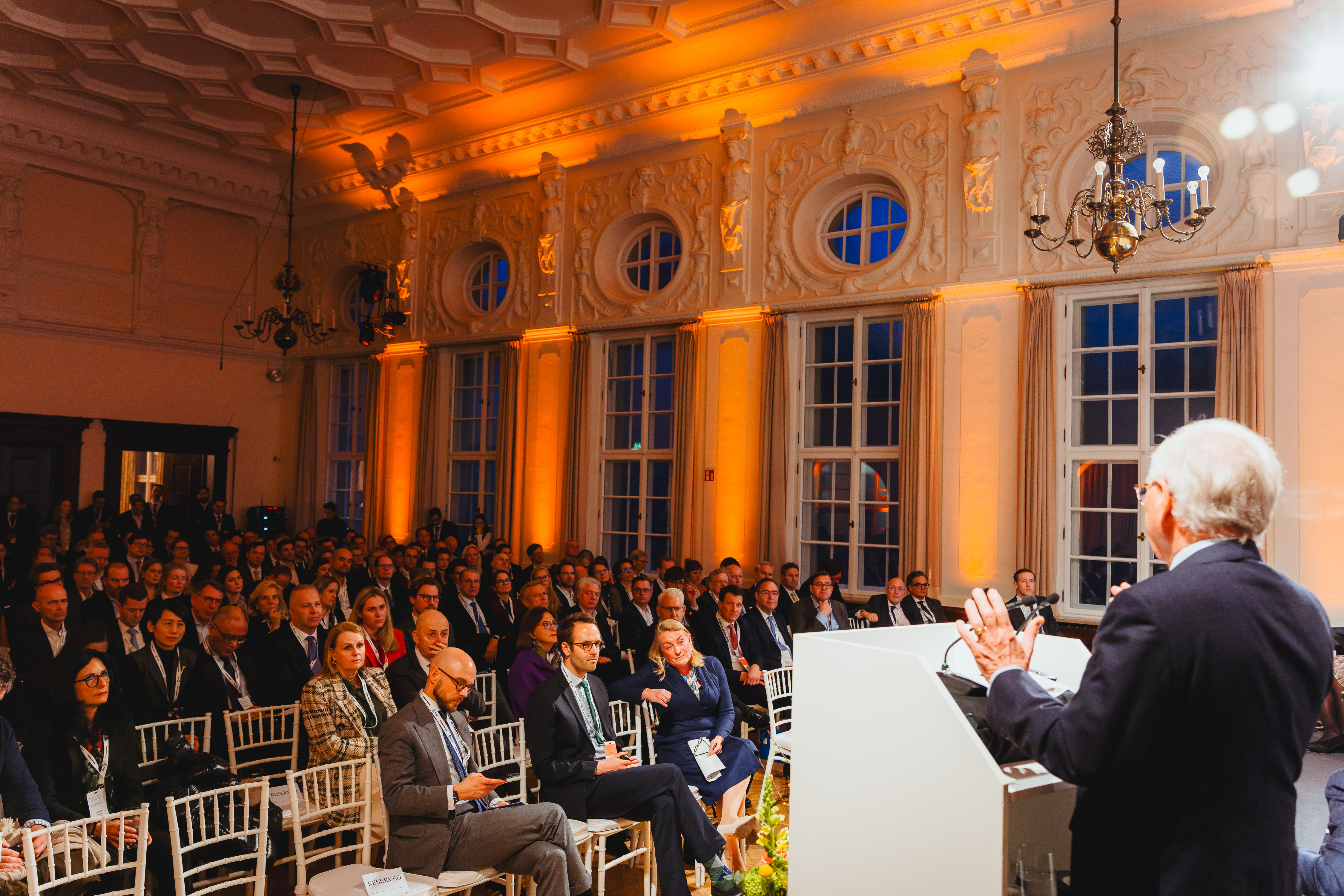
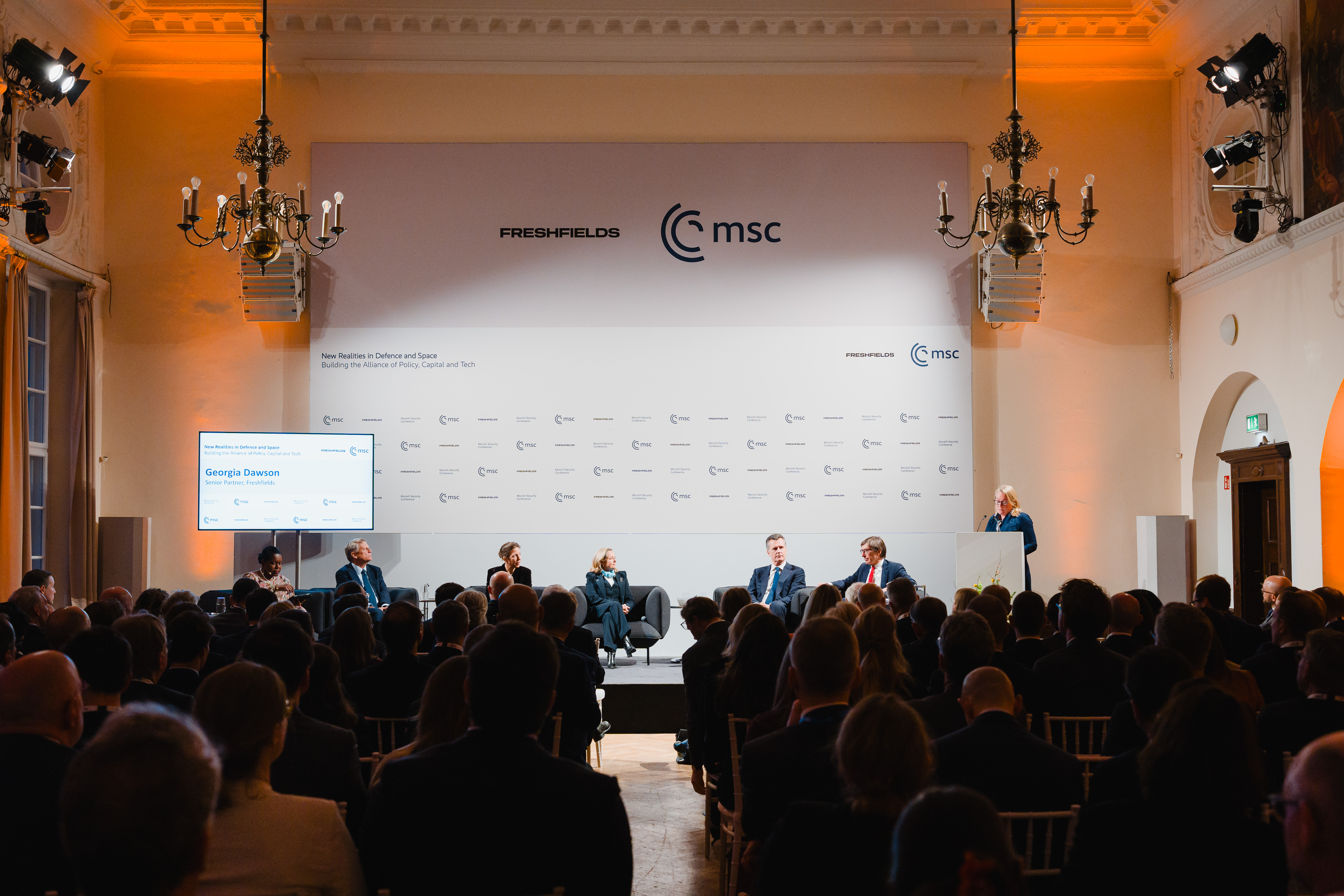
These were the themes explored at Freshfields’ panel discussion at the Munich Security Conference, which brought together senior voices from policy, finance and industry, including Wolfgang Ischinger, Chairman of the Munich Security Conference; Nadia Calviño, President of the European Investment Bank; Philipp Hildebrand, Vice Chairman at BlackRock; Michael McFaul, former U.S. Ambassador to Russia; Peter Wittig, former German Ambassador to the UK, U.S. and United Nations; and Hélène Huby, Co-Founder and CEO of The Exploration Company. The discussion was moderated by Ninette Dodoo, Partner and Head of Freshfields’ Antitrust, Competition and Trade practice in China.
What is being tested is not just capability, but the underlying trust that allows systems – political, financial and technological – to function. As Wolfgang Ischinger put it, “We are living in particularly challenging times… One of the missions of this year’s security conference is to restore trust – like repairing a broken chain to get a bicycle running again.”
The direction of travel is clear. Security, resilience and competitiveness are no longer separate agendas. They are being pursued simultaneously, often through the same policy and investment decisions. As Michael McFaul observed, the current moment points towards a “reform of the liberal international order” – not its disappearance, but its recalibration under pressure.
Technology is now a strategic asset
Emerging technologies are no longer simply drivers of efficiency. They are instruments of state power.
Artificial intelligence, quantum computing and space-based capabilities are increasingly embedded in national security strategies. Governments are intervening more directly – through export controls, investment screening and industrial policy – to shape how these technologies are developed and deployed.
This creates a more complex operating environment for businesses. The same technologies that offer scale and advantage are also subject to greater scrutiny. The challenge is not just innovation, but alignment – ensuring that commercial strategy can withstand political and regulatory pressure across jurisdictions.
Space is shifting from exploration to infrastructure.
Satellite systems now underpin communications, navigation, surveillance and resilience in times of crisis. As Hélène Huby noted in the discussion, the question is no longer technological feasibility, but whether procurement models and funding structures can keep pace with innovation.
What is changing is the role of the private sector. Commercial operators are no longer peripheral; they are central to capability. Yet procurement models, regulatory frameworks and funding structures have not fully caught up. Bridging that gap will be critical if governments are to move at the pace required.
Resilience is being designed in
As defence capabilities become more digital, vulnerability moves with them.
Secure networks, cloud infrastructure and data flows are now integral to national security. That raises difficult questions: how to harden systems without constraining innovation; how to manage interdependencies across borders; and how to align commercial incentives with public objectives.
Resilience, in this context, is no longer a compliance exercise. It is a design principle – something that must be embedded from the outset.
Capital will determine capability
If technology defines the frontier, capital determines how quickly it can be reached.
Public funding alone will not deliver the scale of investment required. Mobilising private capital – at speed and with confidence – has become a strategic priority, particularly in Europe. As Nadia Calviño emphasised, this is not simply a question of funding levels, but of structuring investment in a way that supports innovation while maintaining competitiveness and openness.
Philipp Hildebrand reinforced this point, noting that markets are already adjusting to this reality. The issue is not whether capital will move, but how quickly and under what conditions.
A more integrated playbook
What emerges is a more integrated model of competition.
Defence, technology, finance and industrial policy are increasingly intertwined. Decisions taken in one domain now have direct consequences in others. As Peter Wittig’s perspective underscored, the strength of the transatlantic alignment will remain a critical factor in how effectively these challenges are managed.
For businesses, this raises the bar. Strategy can no longer be set purely on commercial terms; it must account for political alignment, regulatory exposure and systemic risk.
This is not a temporary disruption. It is a structural shift in how power is exercised and how markets operate.
For companies operating in or adjacent to defence, space and critical technologies, the priority is clear: anticipate where policy is moving, understand how capital is being directed and position early.
For more information on last year’s conference, please see our blog post.

/Passle/5832ca6d3d94760e8057a1b6/SearchServiceImages/2026-04-02-14-11-16-411-69ce7904e02767932c7e432c.jpg)
/Passle/5832ca6d3d94760e8057a1b6/MediaLibrary/Images/5caf47f7abdfea0b306b985f/2021-08-16-10-10-30-866-611a3996400fb311c899dbf1.jpg)